
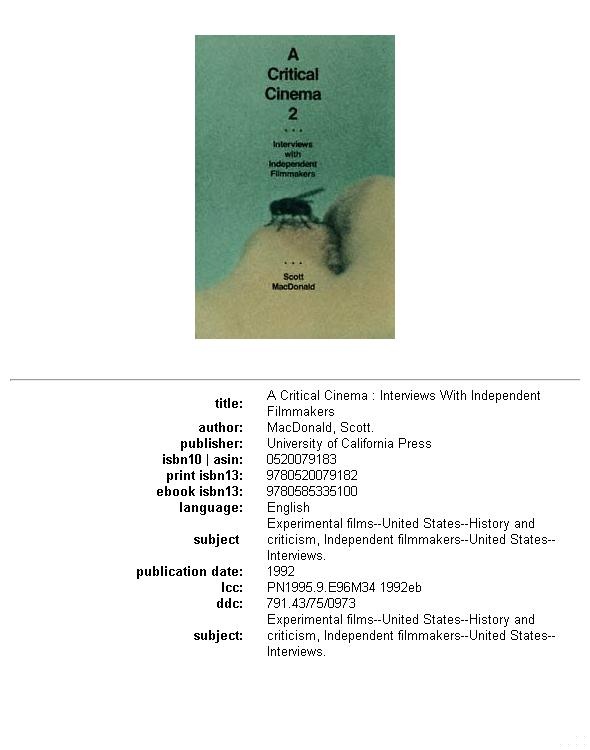
Читаем A Critical Cinema 2: Interviews with Independent Filmmakers полностью
Next, I tried to use what we had developed in this campaign as a prototype and take the issues into a national forum. A conference was being developed at the University of Chicago for principal lawmakers around the country. Senator Sam Irvin was going to keynote it. We had worked with Lawrence Baskir, who was the chief consul and researcher for the Senate Subcommittee on Constitutional Rights. We had given them a lot of material and felt we were in a position to launch a national campaign. We wanted to show that this was a pattern
to the information society, that in fact
had extensive files on them, and that police and planning bureaucracies were using computers, aggregate statistics, to do all of their prognosis and policy development, that drugs were being used, from Ritalin in schools to Prolixin [a strong tranquilizer] in the prisons.
That campaign didn't work out, but I wanted to continue to explore media and I felt that film might give me more access to the public. Of course, having never made a film, having no credibility, I found it agonizing to get support. Basically, I found "angel support," people who were not interested in the return on their investment, but loved our project.
took seven years.
Let's do a timetable. When did you form this collective?
In the early seventies.
This local campaign that was so successful was in . . .
1974. We worked on
from 1975 to 1982.
When you look at the film now, can you see its history? Were certain kinds of things shot at certain times?
Well, we started to shoot the film in 16mm because at first
Page 386
that was the only film technology we could commandthough we always wanted to go to 35mm. I was so excited by what we garnered in 16mm that we went back to some of the people who had shown interest in the project. They shared our excitement and said we should shoot in 35mm. What began as a forty-thousand-dollar, thirty-minute, 16mm film became a demo. I put Tomita's rendition of Mussorgsky's
on what had been shot and used that to show people what the power of this project could be. That got me the money to work in 35mm. I went back and reshot a lot of the locations, although in one case, 16mm footage remains in the 35mm film: the material on Pruit Igoethe first example of a mass housing development in response to poverty. Housing and Urban Development (HUD) built this monstrosity in Saint Louis, and we were fortunate to be able to film it in 16mm once it was abandoned. I use it as a metaphor. When we were ready to shoot in 35mm, most all those buildings had been torn down, so we took that original 16mm, cleaned it up with an opal glass and wet gate process at Disney, and blew it up to 35mm. The grain structure held up.
You mentioned "angel support." Was that local here?
No. It was support that had been identified and located during the ACLU campaign. I'd guess upward of seventy people put in money, but it was the faith of one person putting in close to two million dollars that got this film made. That person has requestedand I have honored that requestto remain anonymous. That same person continued to support us through
(a 4.2-million-dollar film), putting in two million dollars. Cannon put in the other two million, for a paper dealmeaning we got bank financing and they had negative pickup. Cannon [Releasing Corporation] got all the rights, so in fact this gentleman was willing to make a bad deal for love of the project. He got net points way down the line but will probably never realize anything off it. Cannon will take most of whatever profits there are. Though, I must say, Menahem Golan and Yuram Globus at Cannon were very fine to me: they
interfered and gave me full creative control, which of course I required.
Let's go back to
: it must have felt strange to be involved in such a big project.
Well, after the ACLU campaign, I was not mystified by media, but from ten-, thirty-, and sixty-second spots to a 35mm feature is quite a jump. In fact, no one who worked on
had ever made a feature. The cinematographer had only shot 16mm . . .
Ron Fricke?
Yes, I was sure if he had the right tools, and if he could hear what I was asking for (which, it turned out, he could; we were able to work together quite well), he would do a fine job. By
becoming
Page 387
mystified, we were able to get on top of the project; in fact, we were able to come from a more original place than we might have, had we gone to film school and learned the "correct" procedures.
Все книги серии A Critical Cinema
Похожие книги



- Мистика
- Историческое фэнтези
- Ироническая фантастика
- Альтернативная история
- Технофэнтези
- Постапокалипсис
- Киберпанк
- Детективная фантастика
- Стимпанк
- Героическая фантастика
- Научная Фантастика
- Эпическая фантастика
- Ненаучная фантастика
- Сказочная фантастика
- Космоопера
- Юмористическое фэнтези
- Ироническое фэнтези
- Ужасы и мистика
- Юмористическая фантастика
- Социально-философская фантастика
- Космическая фантастика
- Городское фэнтези
- Боевая фантастика
- ЛитРПГ
- Фантастика
- Современная сказка
- Социально-психологическая фантастика
- Хроноопера
- Ужасы
- Мифологическое фэнтези
- Фэнтези
- Фантастика: прочее
- РеалРПГ
- Славянское фэнтези
- Бояръ-Аниме
- Попаданцы
- Шпионский детектив
- Прочие Детективы
- Маньяки
- Полицейские детективы
- Исторический детектив
- Шпионские детективы
- Классические детективы
- Триллеры
- Криминальные детективы
- Иронические детективы
- Криминальный детектив
- Крутой детектив
- Детективы
- Триллер
- Иронический детектив, дамский детективный роман
- Советский детектив
- Классический детектив
- Политический детектив
- Боевик
- Про маньяков
- Медицинский триллер
- Дамский детективный роман
- Техно триллер
- Юридический триллер
- Боевики
- Исторические детективы
- Политические детективы
- Поэзия
- в стихах
- Эпическая поэзия
- Басни
- Песенная поэзия
- Лирика
- Визуальная и экспериментальная поэзия, верлибры, палиндромы
- Поэма, эпическая поэзия
- Классическая зарубежная поэзия
- Классическая русская поэзия
- Поэзия Востока
- Современная поэзия
- Классическая поэзия
- Современная зарубежная поэзия
- Современная русская поэзия
- Юмористические стихи, басни
- Верлибры
- Палиндромы
- Экспериментальная поэзия
- Визуальная поэзия
- Историческая фантастика
- Историческая литература
- Политика
- Геология и география
- Ветеринария
- Экология
- Государство и право
- Астрономия и Космос
- Математика
- Шпаргалки
- Биохимия
- Обществознание
- Педагогика
- Психология
- Учебники
- Иностранные языки
- Детская психология
- Биофизика
- Прочая научная литература
- Языкознание
- Биология
- Психотерапия и консультирование
- Юриспруденция
- Военная история
- Альтернативная медицина
- Философия
- Медицина
- Зоология
- Физика
- Литературоведение
- Зарубежная образовательная литература, зарубежная прикладная, научно-популярная литература
- Языкознание, иностранные языки
- Биология, биофизика, биохимия
- Обществознание, социология
- Психология и психотерапия
- Востоковедение
- Химия
- История
- Ботаника
- Экономика
- Альтернативные науки и научные теории
- Научная литература
- Рефераты
- Секс и семейная психология
- Книги о войне
- Популярно об истории
- Книги о путешествиях
- Книги по психологии
- Религия и духовная литература
- Детская познавательная и развивающая литература
- Детская образовательная литература
- Книги для дошкольников
- Прочая детская литература
- Детские приключения
- Детская проза
- Детские стихи
- Детские остросюжетные
- Детская фантастика
- Книга-игра
- Буквари
- Фантастика для детей
- Детская литература
- Проза для детей
- Внеклассное чтение
- Игры, упражнения для детей
- Классическая детская литература
- Стихи для детей
- Русские сказки
- Зарубежная литература для детей
- Сказки народов мира
- Зарубежные детские книги
- Сказки
- Детские детективы
- Школьные учебники
- Учебная литература
- Книги для подростков
- Экономика
- Поиск работы, карьера
- Отраслевые издания
- Недвижимость
- Корпоративная культура
- Делопроизводство
- Внешнеэкономическая деятельность
- Бухучет и аудит
- Торговля
- Малый бизнес
- Личные финансы
- Государственное и муниципальное управление
- Краткое содержание
- Ораторское искусство / риторика
- Работа с клиентами
- Стартапы и создание бизнеса
- Маркетинг, PR, реклама
- Карьера, кадры
- Маркетинг, PR
- Финансы
- Личная эффективность
- О бизнесе популярно
- Интернет-бизнес
- Банковское дело
- Менеджмент
- Менеджмент и кадры
- Тайм-менеджмент
- Ценные бумаги, инвестиции
- Кадровый менеджмент
- Политическое управление
- Управление, подбор персонала
- Зарубежная деловая литература
- Деловая литература
- Педагогика, воспитание детей, литература для родителей
- Медицина и здоровье
- Семейные отношения, секс
- Семейные отношения
- Рыбалка
- Отдых / туризм
- Автомобили и ПДД
- Сделай сам
- Прочее домоводство
- Спорт
- Здоровье и красота
- Охота
- Домашние животные
- Коллекционирование
- Хобби и ремесла
- Кулинария
- Развлечения
- Сад и огород
- Боевые искусства, спорт
- Домоводство
- Здоровье
- Эротика и секс
- Домашнее хозяйство
- Интерьеры
- Хобби / увлечения
- Мода и стиль
- Красота
- Секс / секс-руководства
- Йога
- Изобразительное искусство
- Рукоделие и ремесла
- Спорт / фитнес
- Прикладная литература
- Компьютерное «железо»
- Базы данных
- ОС и Сети
- Интернет
- Программное обеспечение
- Программирование
- Прочая компьютерная литература
- Учебные пособия, самоучители
- ОС и Сети, интернет
- Программирование, программы, базы данных
- Компьютерное 'железо' (аппаратное обеспечение), цифровая обработка сигналов
- Зарубежная компьютерная, околокомпьютерная литература
- Цифровая обработка сигналов
- Средневековая классическая проза
- Современная проза
- Классическая проза
- Готический роман
- Антисоветская литература
- Военная проза
- Проза прочее
- Роман
- Повесть
- Новелла
- Сентиментальная проза
- Рассказ
- Историческая проза
- Контркультура
- Эпистолярная проза
- Русская классическая проза
- Советская классическая проза
- Магический реализм
- Проза
- Зарубежная классическая проза
- Классическая проза ХX века
- Классическая проза ХIX века
- Роман, повесть
- Фантасмагория, абсурдистская проза
- Афоризмы, цитаты
- Экспериментальная, неформатная проза
- Проза о войне
- Современная русская и зарубежная проза
- Классическая проза XVII-XVIII веков
- Афоризмы
- Эпопея
- Феерия
- Семейный роман/Семейная сага
- Эссе, очерк, этюд, набросок
- Малые литературные формы прозы: рассказы, эссе, новеллы, феерия
- Зарубежные приключения
- Современная зарубежная литература
- Зарубежная драматургия
- Зарубежная фантастика
- Зарубежный юмор
- Зарубежная религиозная литература
- Зарубежная образовательная литература
- Зарубежная публицистика
- Зарубежная психология
- Зарубежные любовные романы
- Зарубежная поэзия
- Зарубежная классика
- Зарубежная старинная литература
- Зарубежная компьютерная литература
- Зарубежная литература о культуре и искусстве
- Зарубежные детективы
- Зарубежная прикладная литература
- Зарубежное фэнтези
- Зарубежная справочная литература